
Hi everyone, I’m Carlos, the owner of a small craft brewery in Santiago, Chile. Today I want to talk about a topic that really hurts – filling loss.
You might think, “Filling is just putting beer into bottles. How much can you really lose?” I used to think the same. Then I actually sat down and did the math, and I realized that the beer I was throwing away every year was worth enough to buy another small brewing system.
The traps I fell into: 7 ways filling loss leaked away
First, a quick definition: filling loss is the difference between the actual amount of beer in the bright beer tank and the amount that ends up as finished product (including both good and defective bottles), expressed as a percentage. I can’t remember the exact formula, but I know the pain all too well.
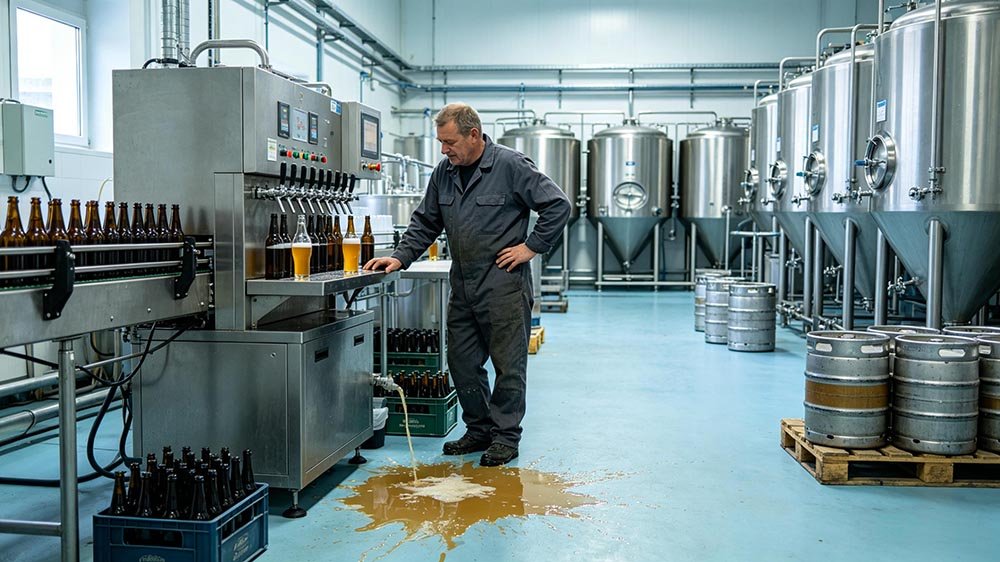
With my old equipment, I suffered from almost every single type of loss:
- Beer left in the tank and pipes – You can never drain a bright beer tank completely. There’s always some leftover. If your operators aren’t skilled, you can leave over 100 liters each time. Sure, you can recover it, but recovery also costs money.
- Leaks during filling – Poor seals on filling valves and beer hoses meant constant dripping. Watching that golden beer spill onto the floor – it broke my heart.
- Rejected defective bottles – Because of air leaks, foreign particles inside the bottle, or cracks in the glass – each one thrown away was money down the drain.
- Bottle bursts during pasteurization – Poor temperature control caused bottles to explode, caps to pop off, and the beer to be completely lost.
- Fobbing loss – Poor filling machine quality, wrong filling temperature, or incorrect pressure control – the beer would gush out as soon as the cap went on. Impressive to watch, but painful to pay for.
- Underfills – Bottles that didn’t meet the fill volume standard and had to be rejected.
- Bottle quality issues – Bottles with larger capacity than standard meant more beer per bottle than intended. Thin walls, crooked bodies, or too‑small mouths caused breakage during filling.
With my old setup, filling loss was consistently above 8%, sometimes even over 10%. That meant for every 100 liters of beer, at least 8 liters were wasted. Over a year, the losses kept me up at night.
The turning point: I found a truly knowledgeable team
I talked with the engineers at Zorime. They asked detailed questions about my filling line, then hit the nail on the head: “Your high loss comes mainly from poor equipment sealing, low filling accuracy, and unstable temperature control. We can help you bring those numbers down.”
How they helped me “plug the leaks”
Zorime provided me with a complete filling solution, including:
- Upgrading the filling valve seals on the filler – leak points nearly eliminated.
- Optimizing the filling temperature and pressure control system – fobbing almost completely gone.
- Improving the pasteurization temperature curve – bottle burst rate dropped significantly.
- Providing a high‑precision fill level detector – underfills became almost non‑existent.
- Training my operators on how to properly recover tail beer and reduce residuals.
With the new equipment, my filling loss dropped from over 8% to around 2.5%. Don’t underestimate that 5.5 percentage point improvement. With an annual output of 200 kiloliters, that means an extra 11 kiloliters of sellable beer – which translates to tens of thousands of dollars in pure profit.
My sincere thanks
Now I understand that filling loss is not a small figure – it directly affects your bottom line. Good equipment not only helps you brew great beer, but also turns every drop of that beer into money.
-300x83.png)