
Hi everyone, I’m Mike, a brewer from Melbourne, Australia. Today, I want to share an experience that still haunts me. If you‘re in the craft beer business, I hope you never make the mistakes I did.
That batch of beer sent three regular customers to the hospital
Three years ago, my small brewpub had just opened. There was a batch of wheat beer that tasted a bit sour, but I thought it was just part of the flavor profile and didn’t think much of it. Then that night, three regular customers went home with severe vomiting and diarrhea. The next day, they called demanding answers. My mind went blank — oh no, bacterial contamination.
I sent the beer for testing, and the results came back: E. coli (exceeded the limit). At that moment, I wished the ground would swallow me up. I make beer to bring people joy, not to make them sick.
What went wrong?
Looking back, those contaminations could have been avoided. But back then, I knew nothing about this.
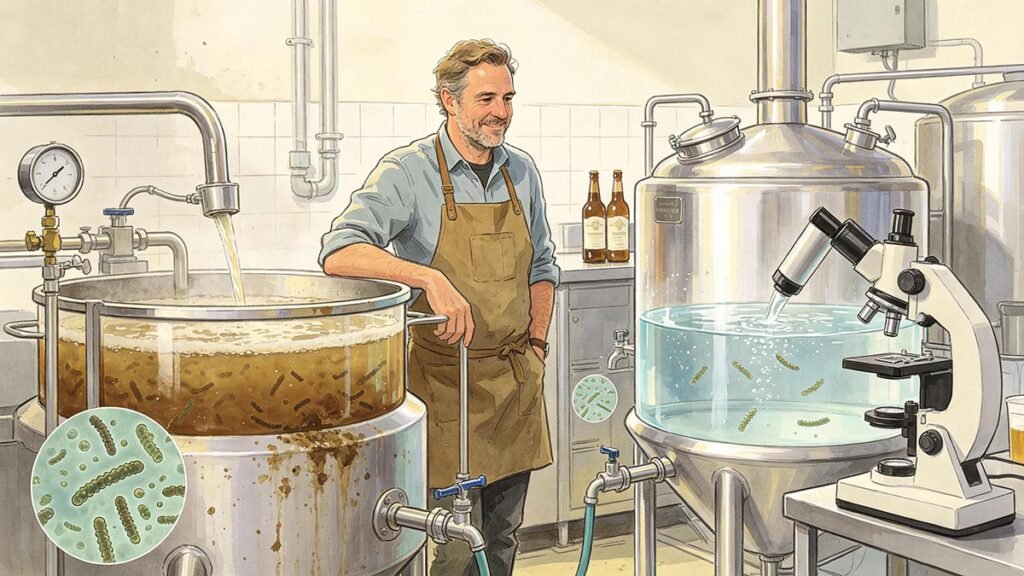
- coli — I later learned that this bacteria infects wort (most easily) during the period from cooling to yeast pitching, multiplying millions of times in just a few hours. That batch got contaminated because my cooling pipes were not cleaned properly, and bacteria hid in the residual scale.
- Lactobacillus thermophilus — This bacteria thrives at temperatures below 50°C, often infecting during the early mashing stage if temperature control is poor. I used to be careless with mashing, heating too slowly, giving them a chance.
- Acetic acid bacteria — These multiply quickly during beer storage if there’s air at the top of the tank. One batch of IPA had a distinct sour and vinegary taste because of this.
- Lactobacillus and Zymomonas anaerobia — These anaerobes grow during storage. Although hops suppress Lactobacillus to some extent, once Zymomonas breaks out, the whole tank is ruined.
- Flavobacterium proteus and Lactobacillus pastorianus — These can even be introduced during yeast propagation. Flavobacterium proteus is particularly stubborn, competing with yeast for nutrients and only stopping growth at the end of fermentation. Lactobacillus pastorianus grows faster in closed fermentation.
I was at my wit‘s end. I tried all sorts of makeshift solutions, changed several batches of ingredients, even questioned my recipes, but the problems kept recurring.
Getting help from the company
In that desperate situation, I urgently contacted my equipment supplier. Zorime’s engineer came to my brewery and, without saying a word, carefully inspected every pipe, tank, and valve. Then he handed me a list with more than a dozen hidden risk points I had never noticed.
He told me, “Brewing isn‘t just about recipes and ingredients — it’s about microbiological control. What you‘re missing isn’t better technology, but a cleaning and management system that allows you to prevent bacteria before they appear.”
Then they helped me with three things:
- Redesigned the CIP cleaning process — Before, I just rinsed roughly. They developed a complete protocol including alkali wash, acid wash, and hot water sanitization, and taught me how to test for residual colonies.
- Upgraded key valves and piping — My old valves had sanitary dead legs where bacteria hid and couldn‘t be cleaned. They replaced them with zero‑dead‑leg sanitary valves and modified the piping to a no‑retention design.
- Taught me aseptic operation procedures throughout brewing — From wort cooling to yeast propagation, from headspace management of storage tanks to sampling port sterilization — every step has strict standards.
They also provided regular remote guidance. Every time I sent a photo of a cleaned tank interior, they could point out where potential risks might still exist.
Now, I’ve had zero contamination incidents
Ever since the retrofit according to Zorime‘s methods, my beer has never had a bacterial problem again. My customers drink with confidence, and I sleep soundly. Most importantly, those three regular customers who got sick — I later invited them back to taste the new batches. They not only forgave me but became my most loyal advocates.
My sincere thanks
To be honest, I used to think that as long as I bought a set of equipment and learned a recipe, I could make money. I nearly ruined my reputation and even faced legal trouble because of bacterial contamination. Now I understand: a good set of equipment, combined with professional hygiene management knowledge, is the most reliable “amulet” a brewer can have.
If you’re also navigating the craft beer path, don‘t gamble with your customers’ health like I did. Finding a partner who truly knows the craft and is willing to teach you hands‑on is more important than anything else.
-300x83.png)