
In the craft beer production process, the choice of bright beer tank directly affects beer storage, carbonation, and filling performance. Vertical and horizontal bright beer tanks each have their own pros and cons. Today, let’s talk about the differences and help you make a more informed decision.
Let me ask you a question first: What’s your approximate daily beer output? Is your facility indoors or outdoors? These factors will influence whether you choose a vertical or horizontal tank.
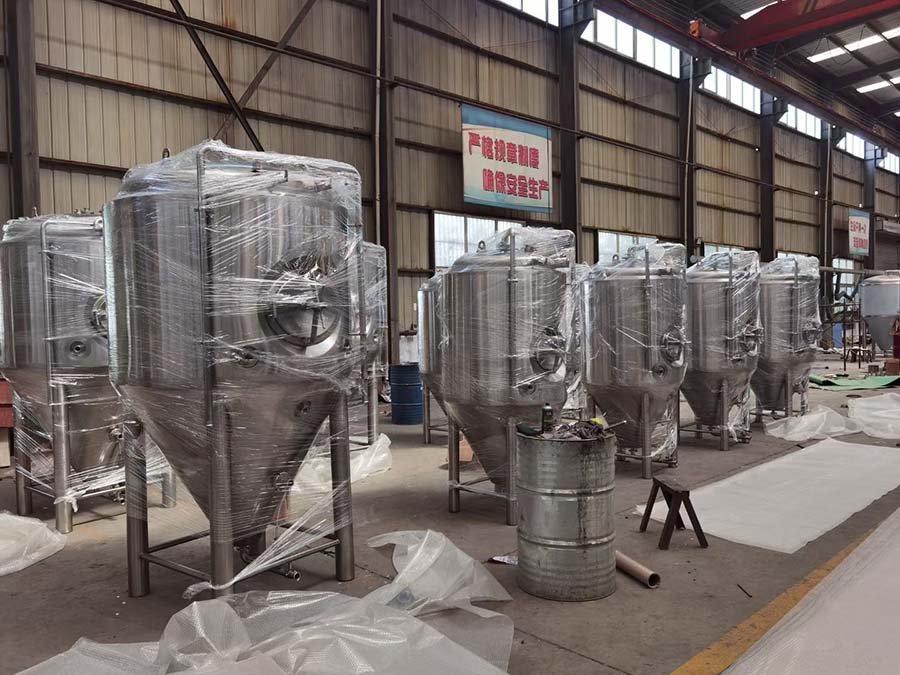
I. Vertical Bright Beer Tanks
Advantages:
- Small footprint, suitable for spaces with limited area.
- The contact surface between beer and compressed air (oxygen) is small (only the cross-sectional area of the tank), resulting in lower dissolved oxygen levels, which helps maintain beer freshness and flavor stability.
- The liquid level is higher, allowing beer to flow smoothly into the tank, and a lower transfer pressure can be used during filling.
Disadvantages:
- Due to pressure resistance limitations, the diameter cannot be too large, so the single-tank capacity is limited. To achieve large capacity, the tank must be very tall (10–15 meters) and requires a CIP cleaning system; otherwise, cleaning is difficult.
- The liquid level is 2–3 times higher than that of a horizontal tank, requiring greater pressure to feed beer into the tank (approximately 0.0098 MPa additional pressure per meter of height increase), which correspondingly raises the pressure needed for filtration.
Higher ceiling clearance is required for indoor installation.
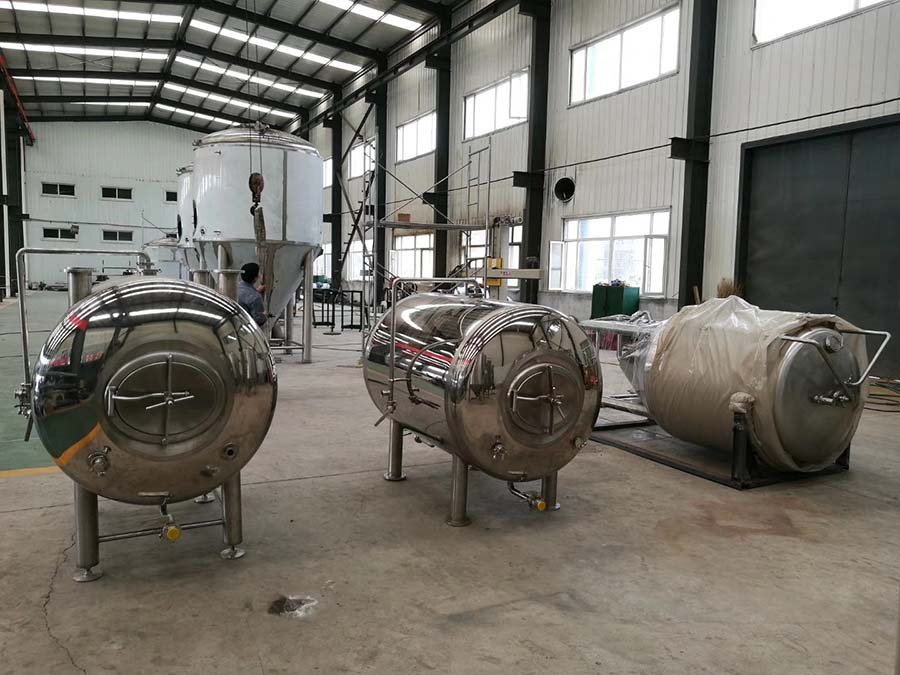
II. Horizontal Bright Beer Tanks
Advantages:
- Single-tank capacity can be very large (the largest domestic horizontal tanks reach 1500–2000 hl), and cleaning is convenient – either manually or with a mobile CIP unit.
- The diameter generally does not exceed 2.5 meters, providing better pressure resistance.
- Tank height equals diameter, so liquid pressure does not exceed 0.3 MPa, requiring lower feed pressure, and the pressure for secondary fermentation tanks can also be lower.
Disadvantages:
- Large footprint, requiring ample space.
- The contact surface between beer and compressed air depends on the tank length (D × L). The longer the tank, the larger the surface area, the higher the dissolved oxygen, which is detrimental to beer’s oxidation resistance.
- When feeding beer (especially at the start of filtration with high flow rates), surging and foaming are more likely to occur, and more compressed air is consumed during filling.
Overall Recommendation
From practical use, smaller-volume (150–200 hl) vertical bright beer tanks perform better, saving space while effectively controlling dissolved oxygen. If your output is large and you have plenty of space, horizontal tanks are also a viable option, but be sure to strengthen anti-oxidation measures.
One more thing: Regardless of which tank type you choose, equipment reliability and after‑sales support are crucial. Our company is located in the birthplace of China’s brewing equipment industry, surrounded by a rich industrial ecosystem. Spare parts are readily available, and after‑sales response is timely. Our brewing technology is among the best in the country, our employees are reliable, and our products offer high cost‑performance. When you buy our equipment, you also receive classic beer recipes and raw material sourcing channels – so you can brew great beer from day one, achieve fast payback, and enjoy sustainable profitability.
-300x83.png)