
In today’s rapidly evolving craft brewing industry, air-lift fermentation tanks are being adopted by more and more small and medium-sized breweries due to their simple structure and high oxygen transfer efficiency. Common types include air-lift loop reactors, bubble column reactors, and air-jet reactors. The core principle involves injecting sterile air through nozzles or orifices into the fermentation liquid. The turbulent flow of the gas-liquid mixture breaks the air bubbles into fine particles. Meanwhile, because the density of the gas-liquid mixture decreases, it rises, while the fermentation liquid with a lower gas holdup sinks, creating a circulating flow that achieves efficient mixing and oxygen mass transfer.
The most widely used systems today include internal-loop air-lift fermenters, gas-liquid dual-jet air-lift loop fermenters, and tower-type air-lift fermenters with multi-layer distribution plates.
Taking the air-lift loop reactor as an example: the tank has no mechanical agitator. A draft tube is centrally placed, dividing the fermentation broth into a riser zone (inside the draft tube) and a downcomer zone (outside the draft tube). An air nozzle or a ring-shaped air distributor with multiple orifices is installed at the bottom of the riser zone. Pressurized sterile air is injected at a high velocity of 250–300 m/s, and the turbulent flow thoroughly disperses the air bubbles, ensuring close contact with the fermentation broth to complete oxygen transfer.
Because the density of the gas-liquid mixture inside the draft tube is lower, and combined with the kinetic energy of the compressed air jet, the liquid moves upward. When it reaches the top liquid surface, some bubbles burst, releasing carbon dioxide, and the fermentation liquid flows from the top of the draft tube outward into the downcomer zone. In the downcomer zone, where the gas holdup is lower and density is higher, the liquid sinks and re-enters the riser zone, forming a circulation loop that achieves efficient mixing and oxygen mass transfer.
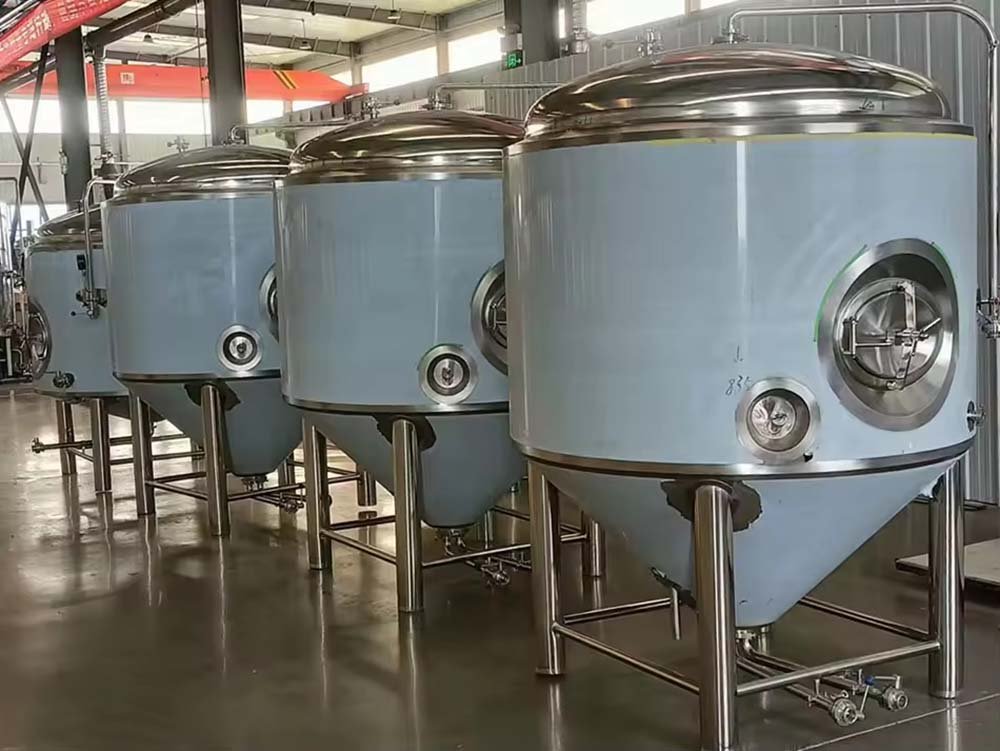
This design not only reduces energy consumption but also minimizes equipment maintenance costs. Getting it right, however, depends on precise coordination of airflow and liquid circulation—something that relies on proven design experience and stable manufacturing processes. Our company is located in the birthplace of China’s brewing equipment industry. The complete industrial ecosystem around us supports every tank’s air system and vessel fabrication, ensuring long-term stable operation right from the start.
Sterilization of the Air Piping System
(1) The air piping system typically includes three-stage pre-filters, an air dryer, and a sterile filter. The pre-filters and air dryer cannot be sterilized with steam. Before introducing steam, close the valves leading to the pre-filters and allow steam to pass through the pressure-reducing valve and steam filter before entering the sterile filter.
(2) The filter cartridge of the sterile filter cannot withstand high temperature and pressure. The steam pressure-reducing valve should be set to 0.13 MPa and must not exceed 0.15 MPa.
(3) During sterilization, the drain valve at the bottom of the sterile filter should be slightly opened to discharge condensate.
(4) Sterilization should last about 40 minutes. For initial use or after prolonged downtime, it is advisable to perform intermittent sterilization—complete one cycle, wait 3–5 hours, and then perform a second cycle to ensure spores are eliminated.
(5) After sterilization, blow the filter dry with compressed air for about 20–30 minutes, then close the air valves.
The air piping is the “respiratory tract” of the fermentation system. If not handled properly, it directly affects contamination risk and fermentation stability. Many of our customers choose our equipment because of the support we provide on these critical details—not just the hardware itself, but having a reliable team that offers process guidance from design through commissioning, helping to clarify potential pitfalls like sterilization procedures and air parameter settings upfront.
Sterilization of the Seed Tank, Fermentation Tank, Alkali Tank, and Defoaming Tank
(1) The seed tank, fermentation tank, alkali tank, and defoaming tank are sterilized by directly introducing steam into the vessels.
(2) During sterilization, slightly open the inoculation port, exhaust valve, and liquid path valves to allow steam to escape through them, while maintaining a tank pressure of 0.13–0.15 MPa.
(3) Sterilization time is 30–40 minutes. Under special circumstances, intermittent sterilization may be used.
(4) Before sterilization, drain the water from the jackets of the seed tank, fermentation tank, defoaming tank, and alkali/acid tanks. After sterilization, drain the condensate from the tanks and open the vent valves to prevent a vacuum from forming as the tank cools, which could damage the equipment. It is recommended to remove the dissolved oxygen (DO) and pH electrodes during sterilization to extend their service life.
While sterilization procedures may look like a standard process, doing them reliably and consistently comes down to attention to detail and a thorough understanding of tank construction. Our company has long been at the forefront of brewing technology in China, and the rich industrial ecosystem around us enables timely parts supply and technical support. Customers choose our equipment not simply because it is the cheapest option, but because they know that from delivery through long-term operation, our people and our supply chain are there to back them up.
Being cost-effective isn’t just about a low price—it’s about stable equipment, reliable processes, and support you can count on at a reasonable investment. That’s what we’ve been quietly doing all along.
-300x83.png)