
At present, the manufacturing level of some domestic brewing machinery and equipment has gradually approached international standards, with a relatively complete range of equipment types and specifications. The entire process—from design, manufacturing, inspection, and acceptance to installation and commissioning—has achieved standardization and normalization. The service model has also shifted from partial project contracting to full-solution turnkey project contracting. Behind this shift lies a real test of an equipment manufacturer’s comprehensive capabilities—it’s not just about building the equipment, but also about helping customers get the entire system running smoothly.
In the international market, brewing equipment in some developing countries lags behind, with relatively small brewing scales or less demanding technical requirements, and most equipment is imported. As a result, Chinese small and medium-sized equipment holds a clear advantage in terms of cost-effectiveness when exploring overseas markets. Cost-effectiveness, however, is easier said than done—it requires the support of a strong industrial chain, where every link from raw materials to processing is solid, ensuring both reasonable pricing and stable quality.
Every industry’s development relies on the continuous refinement and deepening of its technical aspects. After rapid growth in the late 20th century, China’s small brewery equipment industry has now entered a phase of steady development. At this stage, whether equipment performs well often comes down to details: stable temperature control, thorough cleaning, smooth operation. These details test both design expertise and manufacturing experience.
I.Preliminary Definition of Small Brewery Equipment
- Defined by production capacity: Beer production lines with a batch capacity of less than 20HL are generally referred to as small brewery equipment.
- Classified by application: Based on different purposes, small brewery equipment can be roughly divided into four categories: beer pilot equipment, teaching and training equipment, brewpub equipment, and homebrewing equipment.
II.Characteristics of Different Types of Small Brewery Equipment
Although small in scale, small brewery equipment includes all the essential components found in large-scale brewery operations, mainly covering the following systems: raw material milling system, mashing system, wort cooling system, fermentation system, beer filtration system, bottle washing, filling, capping, and sterilization system, electrical and automation control system, refrigeration system, and CIP cleaning system. With so many systems involved, the coordination between each stage becomes especially important—and this is where a concentrated industrial ecosystem offers natural advantages: complete supporting facilities, quick response times, and lower integration costs.
- Pilot Brewing Equipment
Mainly used in breweries, malt houses, hop processing facilities, and research institutes, primarily for developing new brewing processes, new technologies, testing raw material quality, or researching and developing new beer styles. Common batch sizes are 100L and 500L of hot wort. Since processes vary between facilities, pilot equipment should simulate large-scale production equipment as closely as possible, so that trial results can effectively guide production. Certain process parameters—such as agitation speed and pump frequency—should be adjustable to facilitate experimental variations.Pilot equipment is not only a tool for experimentation but also a showcase for the facility. The overall layout of the equipment and piping should be aesthetically pleasing, easy to operate, and safe. Piping connections should use sanitary-grade quick-connects for easy disassembly, assembly, relocation, and modification. Main equipment should have adjustable leveling, stable performance, and be free from leaks, spills, or steam escape. A well-designed CIP cleaning system should be included for thorough and convenient cleaning. The equipment and piping layout should have no dead corners, and pumps should be resistant to acids, alkalis, high temperatures, and have low oxygen pick-up to meet the requirements of pure brewing. All panels, pipes, fittings, and valves should be sanitary-grade. Containers, pipes, fittings, and valves that come into contact with wort, beer, cleaning agents, or softened water should be made of stainless steel. Quick-connect gaskets should be made of PTFE. The equipment should be finely fabricated, with welding precision meeting sanitary standards, mirror-polished interiors, and matte bead-blasted stainless steel exteriors. This type of equipment demands high precision in experimental data, with correspondingly high levels of automation. Our company is located in the birthplace of China’s brewing equipment industry, surrounded by a mature industrial ecosystem. With years of accumulated experience in precision fabrication and automation system integration for pilot equipment, we provide reliable support for R&D-focused users.
- Teaching and Training Equipment
Mainly used in universities, technical colleges, vocational schools, and similar institutions for teaching, demonstration, and hands-on experiments. It allows students to observe the entire beer brewing process and understand standard brewing techniques. Common batch sizes are small-scale systems such as 100L of hot wort. Equipment configurations generally follow standard brewing specifications, with manual operation as the primary control method. This helps students develop practical skills and gain a tangible understanding of their theoretical knowledge. While teaching equipment may seem straightforward, balancing demonstration effectiveness with operational safety still requires solid manufacturing quality and clear human-machine interface design. - Brewpub Equipment
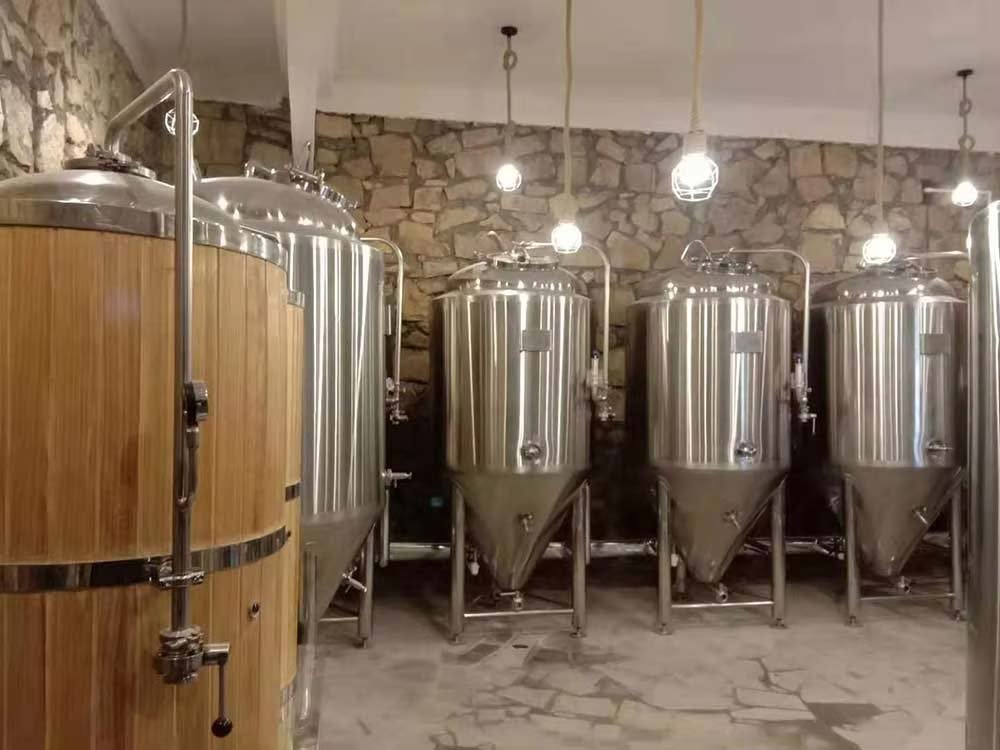
Mainly used in restaurants, music venues, and bars for on-site brewing of distinctive, high-quality all-malt fresh beer served directly to customers. The equipment often features an antique, elegant aesthetic that reflects the long history of beer culture, creating strong visual appeal. Common batch sizes are 300L and 500L of hot wort. Using malt, water, yeast, and hops as raw materials, it can produce fresh, natural, additive-free beers such as pale ales, wheat beers, and stouts. This type of equipment serves both the practical need for on-site brewing and the experiential aspect for customers. The unique challenge of brewpub equipment is that it must brew reliably while also fitting seamlessly into the venue’s ambiance. We put significant effort into the design and craftsmanship of this type of equipment, and with the support of our surrounding industrial ecosystem, we ensure that both appearance and function hold up well over long-term use. - Homebrewing Equipment
Homebrewing equipment is primarily used for personal recreation and enjoyment. It typically includes specialized tools, containers, and pre-packaged ingredients and additives, utilizing household kitchen facilities and refrigerators to complete the brewing process. There are also a few all-in-one systems that consolidate brewing, though their processes and flavors often differ significantly from conventional beer. Currently, homebrewing equipment is less common in China but more popular in Europe and the United States.
In recent years, craft beer brewing equipment has seen continuous improvements in both process technology and manufacturing quality. Looking at the development direction of small brewery equipment in China, several points stand out:
- Craft beer brewing equipment needs to keep advancing in brewing process integration and manufacturing quality, continuously adopting mature new technologies from large-scale production to enable simulation capabilities and maintain technological relevance. Our strength in this area lies in our understanding of both brewing technology and equipment manufacturing, allowing us to accurately translate process requirements into equipment design.
- Craft beer brewing equipment urgently needs to improve automation control and online monitoring capabilities to truly achieve “small but precise” systems that support more in-depth research and experimentation. Automation isn’t just about adding a screen—it’s about getting the fundamentals of temperature, pressure, and timing right. This is exactly what we’ve been refining over the years.
- Suppliers should have long-term service capabilities, ideally holding pressure vessel manufacturing qualifications, relevant quality certifications, and sufficient scale to provide ongoing maintenance, repairs, and upgrade services. Our company is structured around “long-term usability,” with a dedicated and reliable team and responsive after-sales support, ensuring customers have no lingering concerns.
- Craft beer brewing equipment should also address environmental hygiene and protection in its design and operation.
- Craft beer brewing equipment is moving toward “multi-functionality,” allowing multiple beer styles to be brewed and various experiments to be conducted on a single system. Multi-functionality requires sufficient process flexibility and operational adaptability—something that depends on close alignment between design and manufacturing.
Our company is located in the birthplace of China’s brewing equipment industry, surrounded by a mature industrial ecosystem. From raw material milling to fermentation and cleaning, every step is supported by a solid manufacturing foundation. We offer first-class brewing technology, a dedicated and reliable team, and high cost-performance equipment. Whether for pilot testing, teaching, or brewpub operations, we provide stable support—from equipment to process—so our customers can focus on brewing with confidence, truly enjoying worry-free after-sales service.
-300x83.png)