
In the craft beer brewing process, the saccharification and breakdown of malt directly determine the quality and yield of the resulting wort. The heating system and agitation system in the mash tun, in turn, directly decide the success or failure of the mashing process. The production flexibility of craft beer naturally leads to a wide variety of mash tun configurations. This article discusses the importance of the mash tun in small brewery equipment.
For a single-vessel craft brew house, the heating rate during mashing is generally controlled at 1–1.5°C per minute. The three main heating methods are steam heating, electric heating, and direct gas firing.
Steam heating is typically provided via a jacket on the bottom and/or the side wall of the vessel. For many small-scale craft systems, a bottom jacket alone is sufficient.
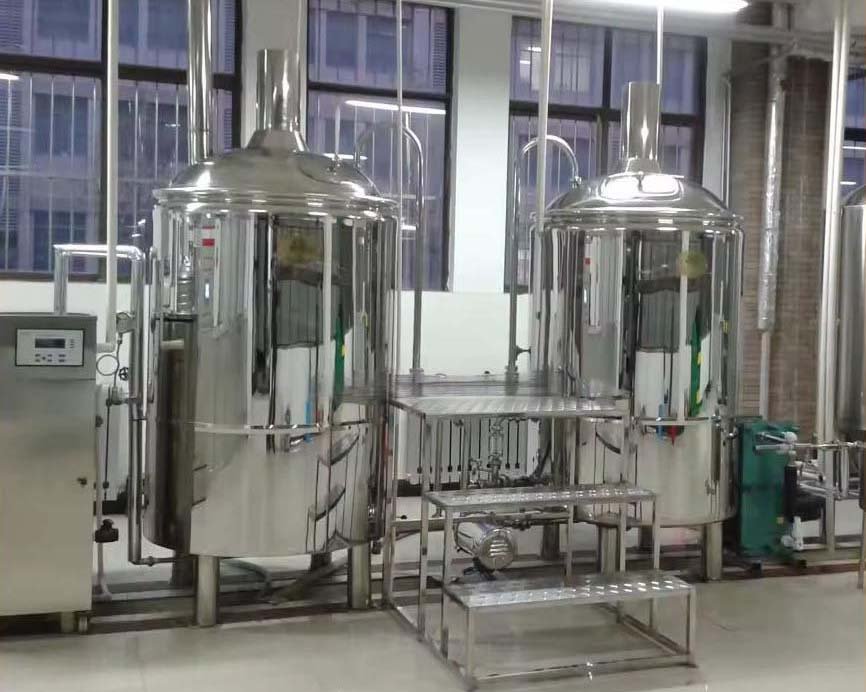
Theoretically, the larger the heat transfer area of the jacket, the better. However, in a small craft mash tun, the heat exchange area per unit volume of mash is often already greater than that in large industrial systems. If the jacket covers the entire vessel surface, the result can be counterproductive: steam entering the jacket quickly condenses, so only the first part of the jacket is actively heating while the rest remains idle. More jacket area can actually lead to uneven heating, wasted material, and increased manufacturing complexity. On the other hand, if the jacket area is too small, higher steam pressure is needed to maintain the temperature differential, which can cause localized scorching and create cleaning difficulties.
Electric heating is another common choice for small craft mash tuns. It offers lower capital investment, high thermal efficiency, and the ability to precisely calculate the required power. However, electric heating elements have a much smaller heat exchange surface than a jacket, so the power density per unit area is high. This makes them prone to scorching, which not only complicates cleaning but also affects mash quality and shortens the service life of the heaters.
Direct gas firing is highly advantageous for craft breweries with access to natural gas. It requires low equipment investment and avoids the cost and hassle of electrical upgrades. Moreover, the controlled Maillard reaction induced by direct flame can impart unique flavor characteristics to craft beer. However, the burner system may pose challenges in environmental permitting. A major issue in direct-fired systems is the high exhaust gas temperature at the flue outlet, leading to significant energy waste. While a secondary chamber around the vessel sidewall can be added to direct the flue gases before exhausting them, this only partially addresses the problem and does not fundamentally solve the issue of precise exhaust temperature control.
Beyond heating, the agitation system in the mash tun is equally critical. It significantly affects heat transfer, temperature uniformity, mixing, and solid-liquid suspension. A well-designed agitator should provide gentle mixing without creating surface turbulence, minimize oxygen pickup, and exert low shear force to reduce the release of beta-glucans and similar substances. It should also promote vertical circulation within the mash, ensuring uniform and stable turbulence below the liquid surface, allowing enzymes to contact the substrate thoroughly and reducing reaction time. The effectiveness of the agitator directly determines mashing quality and extract yield.
Currently, the gearbox for craft mash tuns is typically installed either on top of the vessel or at the bottom. The top-mounted design is simpler to engineer and manufacture, but the shaft extending down to the bottom can obstruct the spray ball, reducing cleaning effectiveness. Additionally, the exposed gearbox on top may detract from the overall visual appearance.
-300x83.png)