
According to the craft beer production process, craft beer equipment can be divided into two main parts: the brewing (mashing) section and the fermentation section.
The brewing section is used to prepare wort. Based on the process requirements of mashing, lautering, boiling, and whirlpool settling during wort preparation, brewing equipment typically needs to include a mash kettle, lauter tun, brew kettle, and whirlpool tank to complete the above steps in sequence. In craft beer equipment, a common configuration is the two-vessel combined system, consisting of a mash/brew kettle and a lauter/whirlpool combination tank. Dry lautering is used for spent grain removal, which avoids environmental pollution, reduces production costs, and lowers labor intensity. The raw materials used in the brewing process include malt, hops, and water.
The brewing process requires a heat source to heat the materials. Common heating methods include electric heating, steam heating, and direct fire heating. Electric heating uses electric heating elements to directly heat the liquid; steam heating uses saturated steam generated by a steam boiler to indirectly heat the liquid through a jacketed heat exchanger on the brewing equipment; direct fire heating uses a gas flame to transfer heat through the bottom of the vessel.
The wort preparation process is completed in the brewing equipment, and also requires a series of auxiliary equipment, including a steam boiler for generating steam, a grain mill, water treatment equipment, heat exchange equipment, and testing and service equipment for the brewing process. These auxiliary components work together with the brewing equipment according to specific process flows to achieve wort production.
Typically, one brewing cycle takes 6 to 8 hours, and brewers can usually prepare 1 to 2 batches per day. To meet the requirements of different single-batch wort production volumes, common brewing equipment batch sizes include 100L, 200L, 300L, 500L, and 1000L (10HL), with annual brewing capacity increasing accordingly.
The fermentation section is used for beer fermentation. The wort delivered from the brewing section is inoculated with yeast and aerated with oxygen, then transferred to fermentation tanks for fermentation. Brewer’s yeast converts the sugars in the wort into alcohol and carbon dioxide, and through a series of biochemical reactions, also produces various fermentation byproducts. These byproducts determine the beer’s flavor, foam, color, stability, and other physical and chemical properties, while also giving the beer its distinctive character. Therefore, to brew different styles of craft beer, it is necessary to select yeast with different characteristics and combine them with corresponding fermentation processes.
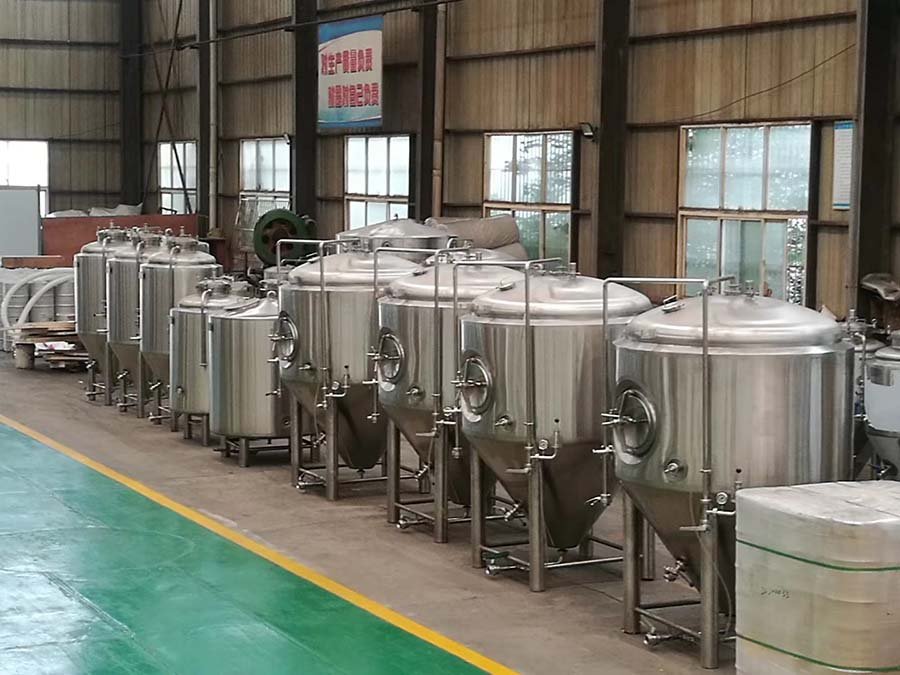
The fermentation system typically consists of multiple fermentation tanks. Both the inner shell and outer shell are made of stainless steel. The tank’s interlayer is filled with polyurethane foam insulation, while a stainless steel cooling jacket is wrapped around the inner tank to maintain the beer at a stable low temperature during fermentation and aging.
Beer fermentation and aging are carried out in cylindrical conical fermentation tanks and various beer storage tanks. Since beer fermentation needs to take place at low temperatures, all storage tanks require cooling temperature control. Typically, tanks are fitted with jacketed heat exchangers, and a dedicated chiller precisely controls the temperature of the cooling medium. The cooling system is used for both wort cooling after boiling and fermentation temperature control, and its optimized design directly affects the energy consumption during equipment operation.
Depending on the fermentation process used, the fermentation cycle for craft beer can vary significantly—ranging from as short as ten days to as long as six months. Generally speaking, craft beers with longer fermentation cycles tend to have higher quality than those with shorter cycles—which means that throughout this extended process, the temperature stability, control precision, and long-term operational reliability of the equipment are all critically important.
Our company is located in the birthplace of China’s brewing equipment industry, surrounded by a complete industrial ecosystem. From the brewing section to fermentation, the process integration and temperature control system configuration of every set of equipment are refined through repeated iteration within this mature industrial environment. Our employees are dedicated and reliable, and our brewing technology is among the best in the country. Whether it’s equipment selection or ongoing process guidance, we provide solid support to our customers.
Cost-effectiveness is not about the lowest price—it’s about delivering equipment that operates steadily and reliably through long fermentation cycles, at a reasonable investment, giving our customers true peace of mind. The industrial ecosystem around us also ensures prompt after-sales service and reliable spare parts supply—this is not just equipment, but the foundation for a long-term partnership.
-300x83.png)